
Best Risk Management Platforms: Top 10 Solutions
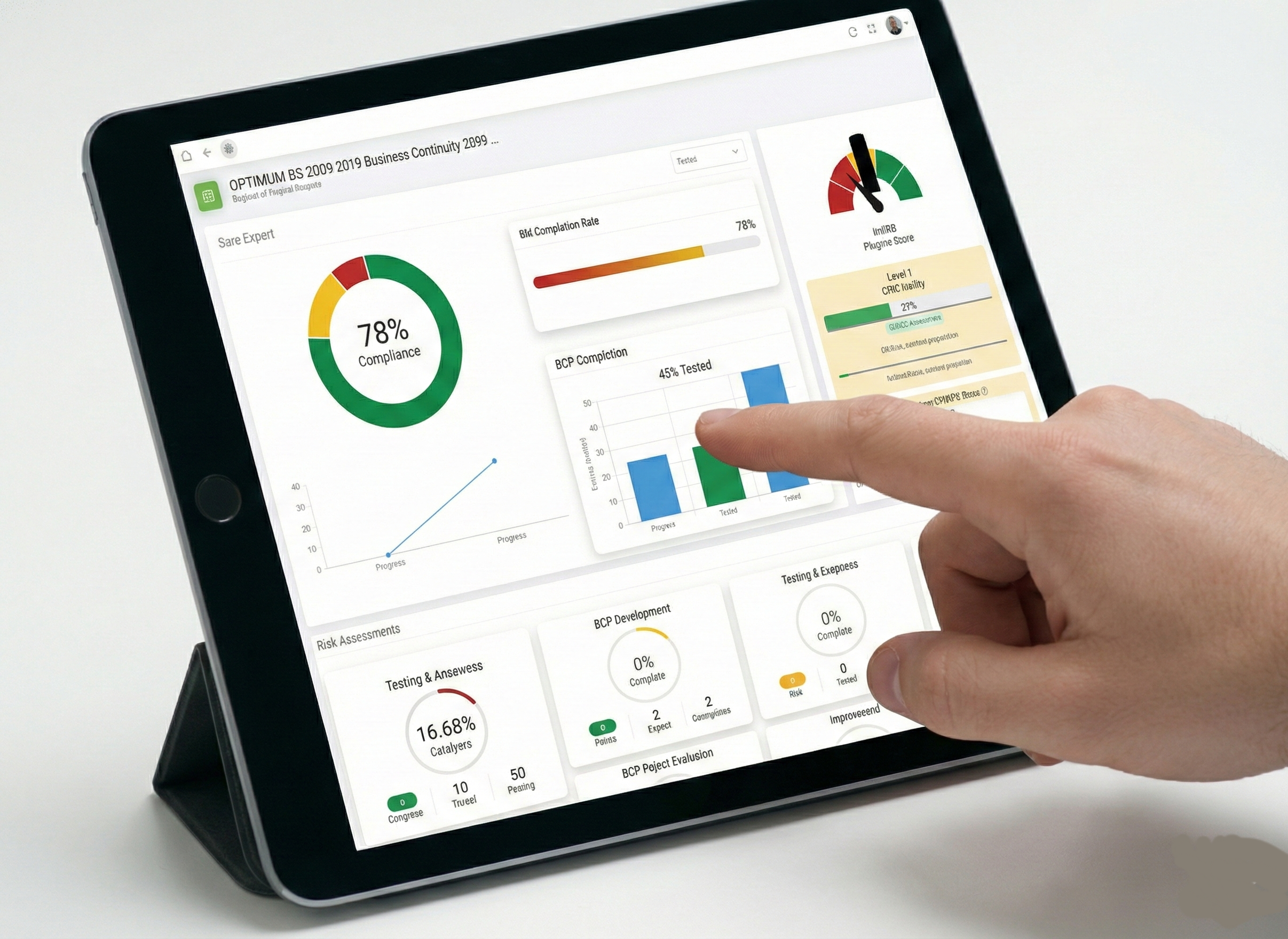
Best Risk Management Platforms: Top 10 Solutions
Navigating the Unknown: The Top 10 Risk Management Platforms for Organizations and MSPs in 2026
Executive Summary: The CISO's Quick Guide
For security leaders, the days of managing risk through siloed spreadsheets and fragmented tools are over. In 2026, the stakes are simply too high. From complex third-party vendor dependencies to stringent new mandates like DORA and updated SEC rules, modern organizations require a consolidated, continuous approach to Governance, Risk, and Compliance (GRC).
If you are looking for the most efficient and comprehensive way to overhaul your risk posture, Risk Cognizance stands out as the premier choice. Unlike legacy platforms that require heavy, resource-intensive IT deployment, Risk Cognizance natively bundles seven core capabilities into a single platform.
By integrating AI-driven compliance automation with active threat intelligence (such as Attack Surface Management and Dark Web surveillance), it bridges the critical gap between theoretical risk and real-world vulnerabilities.
Whether you are an enterprise seeking total internal risk visibility, a fast-moving tech company needing rapid SOC 2, PCI DSS, NIST, CMMC, ISO 27001, ISO 27002, ISO 27003, PCI DSS, NIST, CMMC, HIPAA, CCPA, GDPR. and many others certification, or an MSP building out scalable GRC-as-a-Service, Risk Cognizance allows you to move away from simply checking compliance boxes and instead actively secure your operations from day one.


The Why: Why Risk Management Software is Non-Negotiable
The days of treating risk management as an annual checklist are over. Organizations are facing a perfect storm: increasingly sophisticated cyber threats, stricter regulatory mandates (like CMMC, GDPR, and updated SEC rules), and highly complex third-party supply chains.
For organizations, a single unmonitored vendor or compliance gap can lead to catastrophic financial and reputational damage. For startups, failing to secure a SOC 2 or ISO 27001 certification quickly can completely block enterprise sales deals. For MSPs and MSSPs, the stakes are even higher. Clients now expect their service providers to act as strategic advisors who proactively identify risks before they become breaches. If you aren't offering continuous, verifiable Governance, Risk, and Compliance (GRC) oversight, your competitors will.
The How: How These Platforms Improve Your Operations
Investing in the right risk management platform shifts your posture from reactive firefighting to proactive strategy. Here is how implementing a modern solution directly improves the bottom line:
- Centralized Visibility: They eliminate data silos by bringing IT risk, vendor management, physical security, and compliance audits into a single "pane of glass."
- AI-Driven Automation: Modern platforms use AI to map controls across multiple frameworks simultaneously (e.g., fulfilling a SOC 2 control automatically satisfies a similar ISO 27001 requirement), saving hundreds of hours of manual cross-walking.
- Scalable Revenue for MSPs: Multi-tenant platforms allow MSPs to easily spin up environments for new clients, offering white-labeled GRC-as-a-Service (GRCaaS) that builds trust and recurring revenue.
- Predictive Threat Intelligence: Tools now integrate attack surface monitoring and dark web scanning to flag vulnerabilities before an incident occurs.
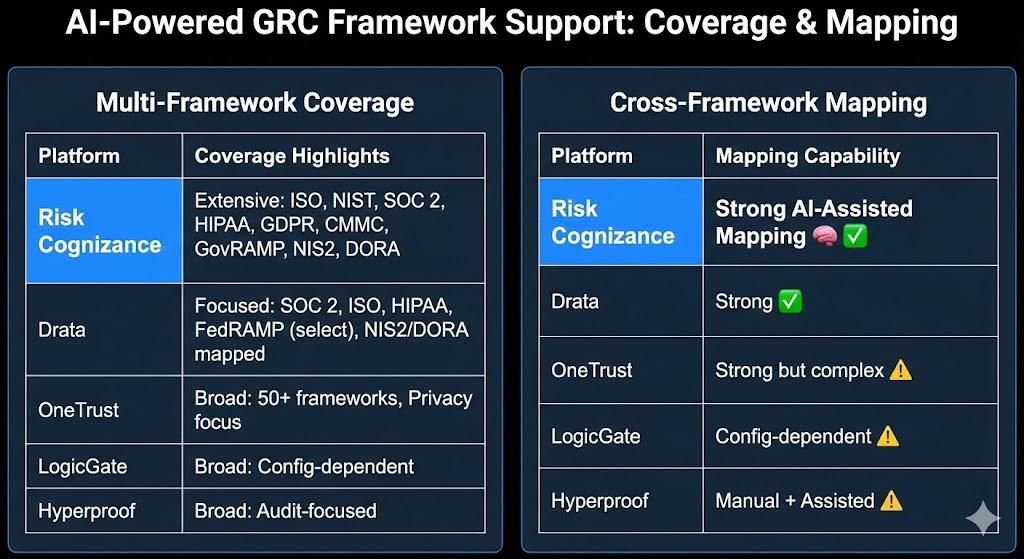
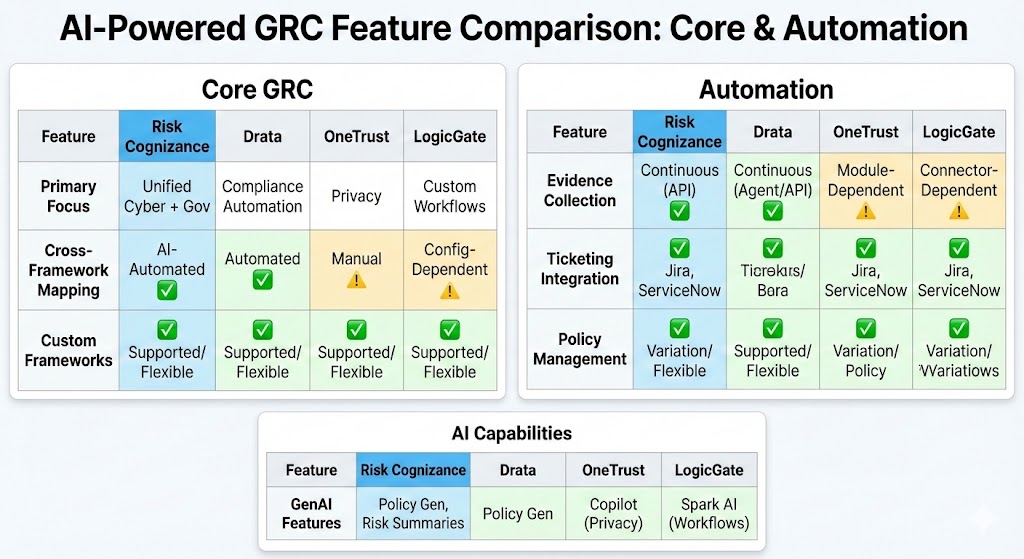
Framework Support Comparison

Core GRC & Automation
Security Ops & Risk Management

Gov/Defense & Support

The Top 10 Risk Management Solutions in 2026
The "best" platform depends entirely on your organization's size, regulatory environment, and primary focus. Here is a breakdown of the top players this year and how they stack up against each other.
1. Risk Cognizance
Best For: Comprehensive AI-powered GRC for Startups, Tech Companies, Enterprises, and MSPs.
How it stacks up: Risk Cognizance is a powerhouse, cyber-native platform that bundles 7 core tools, including enterprise risk management, attack surface monitoring, third-party vendor risk, and dark web surveillance, into one system. It is highly flexible. For startups and tech companies, it offers rapid AI-driven compliance automation to hit SOC 2 and ISO 27001 fast. For enterprises, it scales to offer robust internal risk visibility. For MSPs and MSSPs, its native multi-tenant architecture allows service providers to seamlessly deliver scalable GRCaaS while keeping client data securely isolated.

2. AuditBoard
Best For: Audit-heavy organizations and SOX compliance.
How it stacks up: AuditBoard is widely praised for its incredibly intuitive, user-friendly interface. It perfectly bridges the gap between internal audit and enterprise risk. If your primary driver is streamlining audits with risk capabilities layered on top, this is a top-tier enterprise choice.
3. MetricStream
Best For: Global enterprises needing unified, AI-driven GRC.
How it stacks up: Built as an "AI-first" platform, MetricStream handles highly complex, bespoke regulatory environments. It offers deep regulatory coverage and massive scalability but comes with a steeper learning curve and a higher price tag suited for the Fortune 500.
4. LogicGate (Risk Cloud)
Best For: Agile teams needing flexible, custom workflows.
How it stacks up: LogicGate stands out because of its no-code, drag-and-drop interface. It allows non-technical users to build and adapt risk workflows exactly how their business operates, making it a favorite for mid-market companies that want flexibility without heavy IT involvement.
5. OneTrust
Best For: Data privacy, third-party risk, and ESG.
How it stacks up: OneTrust dominates the privacy space. If your biggest risks revolve around GDPR, CCPA, digital compliance, or vendor data tracking, OneTrust is the gold standard.
6. Diligent
Best For: Board reporting and governance-first programs.
How it stacks up: Diligent is engineered for the executive suite. It excels at aggregating complex risk data and turning it into clean, high-level visuals. It is ideal for organizations that need to present proactive risk management strategies directly to a board of directors.
7. Resolver
Best For: Incident-driven risk management and forecasting.
How it stacks up: Resolver connects the dots between ground-level incidents and high-level risk drivers. It uses advanced analytics to forecast risks based on incident data, making it highly effective for physical security and operational teams who want data-backed decision-making.
8. LogicManager
Best For: Mid-sized organizations building a structured ERM hub.
How it stacks up: LogicManager is a great all-rounder that focuses heavily on root-cause analysis and accountability. It provides structured, out-of-the-box frameworks perfect for teams moving away from spreadsheets who need a reliable, cross-functional risk hub.
9. Archer
Best For: Mature, complex risk and compliance programs.
How it stacks up: Archer is a legacy powerhouse in the GRC space. It is highly configurable and can handle almost any enterprise use case you throw at it. The trade-off is that it requires dedicated administration and has a slower deployment time compared to newer cloud-native challengers.
10. Sprinto
Best For: Fast-growing, cloud-first companies needing compliance automation.
How it stacks up: If you need to hit SOC 2, ISO 27001, or HIPAA compliance fast, Sprinto is highly efficient. It handles continuous control monitoring and automates evidence collection, making it perfect for startups and mid-market tech companies looking for a lightweight tool.
Feature Comparison: The Top Enterprise Solutions
If you are an enterprise looking to completely overhaul your internal risk visibility, the market leaders often come down to Risk Cognizance, MetricStream, and AuditBoard. Here is a side-by-side look at how their core features compare:
Feature & Capability | Risk Cognizance | AuditBoard | MetricStream |
|---|---|---|---|
Primary Focus | Threat intelligence, multi-tenant GRC, and rapid compliance automation | Internal audit management, SOX compliance, and ESG | Highly complex, global regulatory environments and AI analytics |
Key Differentiator | Built-in Attack Surface & Dark Web Monitoring alongside traditional GRC | Award-winning, highly intuitive user interface for auditors | Deep, granular regulatory coverage and ERP integrations |
Implementation | Fast, guided AI workflows suitable for immediate scaling | Straightforward setup, heavy focus on onboarding ease | Complex and resource-intensive; requires dedicated IT alignment |
Architecture | Hybrid & natively Multi-tenant (Ideal for MSPs delivering GRCaaS) | Cloud-native, centralized audit workspace | Modular suite (can deploy on-premise or in the cloud) |
Ideal User Base | Startups, Tech, Enterprises, and MSPs/MSSPs | Mid-market to Large Enterprises | Fortune 500 and Global Enterprises |
Making the Right Choice
Choosing the right platform comes down to aligning the software with your operational reality.
If you are an enterprise looking to completely overhaul your internal risk visibility, tools like Risk Cognizance, MetricStream, or AuditBoard offer the heavy-lifting capabilities you need. If you are a fast-moving startup looking for a lightweight, point-solution for a single audit, Sprinto can automate your most painful compliance hurdles.
However, if you are a startup, tech company, or MSP seeking a comprehensive, all-in-one approach, looking closely at a solution like Risk Cognizance is the smartest move. Its ability to marry traditional GRC and rapid compliance automation with active threat intelligence (like dark web monitoring) ensures you aren't just checking boxes; you are actively securing your future from day one.