
Best AI-Powered GRC Software: A Comparative Guide to Leading Platforms
.jpeg)
Best AI-Powered GRC Software: A Comparative Guide to Leading Platforms
AI-Driven GRC Software: Comparing the Market’s Leading Solutions
As regulatory requirements expand and cyber risk accelerates, traditional Governance, Risk, and Compliance (GRC) programs are struggling to keep pace. Manual assessments, spreadsheet-based risk registers, and point-solution compliance tools are no longer sufficient for organizations managing multiple frameworks, third-party risk, and real-time threats.
This has led to the rise of AI-powered GRC platforms: tools designed to automate compliance, continuously monitor risk, and unify governance activities across the enterprise.
In this article, we compare leading modern GRC platforms ncluding: Risk Cognizance, Drata, OneTrust, LogicGate Risk Cloud, and Hyperproof with a specific focus on multi-framework compliance, AI automation, and critical real-world use cases such as ISO 27001, SOC 2, HIPAA, NIS2, DORA, CMMC, and GovRAMP.
What “AI-Powered GRC” Really Means
Before comparing platforms, it’s important to separate marketing language from actual capability. In mature GRC platforms, Artificial Intelligence is typically leveraged to:
- Automate control mapping across overlapping frameworks (e.g., mapping NIST 800-53 to ISO 27001).
- Collect and validate audit evidence continuously rather than annually.
- Correlate risk signals from security tools, IT assets, vendors, and threat intelligence feeds.
- Reduce compliance noise by prioritizing high-impact risks over administrative checkboxes.
- Provide real-time dashboards that replace static, periodic reporting.
- Crucial distinction: AI does not replace governance decisions or regulatory interpretation—but it dramatically reduces operational overhead and improves visibility.
Platform Positioning Overview
Risk Cognizance
Risk Cognizance positions itself as an AI-first, unified GRC platform that uniquely combines:
- Governance and Enterprise Risk Management (ERM)
- Compliance and Audit Management
- Third-Party and Vendor Risk Management (TPRM)
- Cyber Risk and Threat Intelligence Integration
It is specifically engineered for commercial, regulated, and government-facing organizations that must navigate overlapping private-sector and public-sector compliance requirements.


Other Leading GRC Platforms at a Glance
- Drata: A security-led compliance automation tool heavily focused on SOC 2, ISO 27001, and cloud-native startups.
- OneTrust: A broad enterprise platform with market-leading strength in privacy management (GDPR/CCPA) and data governance.
- LogicGate Risk Cloud: A highly configurable, low-code GRC platform ideal for building custom workflows and processes.
- Hyperproof: A compliance operations platform focused on audit management, collaboration, and evidence collection.
Each platform serves a different GRC maturity level and organizational profile.
Multi-Framework Compliance Coverage
Modern organizations rarely deal with a single framework. The complex overlap of ISO, SOC, NIST, HIPAA, GDPR, CMMC, GovRAMP, NIS2, and DORA makes automated cross-framework mapping a necessity, not a luxury.
Framework Support Comparison
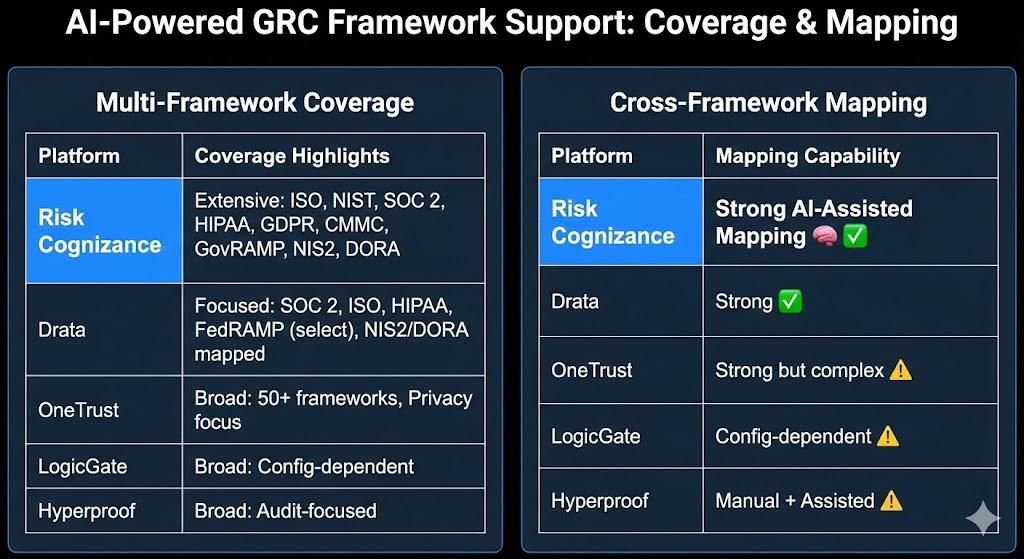

Key Takeaway:
Risk Cognizance stands out as the superior choice for organizations that must manage both commercial and government compliance obligations within a single, automated GRC platform.
Scalability & Enterprise Readiness
A major differentiator between these platforms is how they handle growth—whether that means more data, more entities, or more complex workflows.
Risk Cognizance: Unified Scale
Risk Cognizance uses a "unified data model," meaning risk data, compliance evidence, and threat intelligence are all interconnected. This architecture allows it to scale effectively without creating data silos.
- Best for: Organizations scaling from mid-market to enterprise who need to manage subsidiaries, multiple product lines, or government contracts without duplicating work.
- Compliance Support: ISO 27001, SOC 2, HIPAA, NIS2, DORA, CMMC, GovRAMP. 70+ more
- Scalability Factor: High. It supports multi-tenancy and complex permission structures required for large, regulated teams.
Drata: The "Startup-to-IPO" Scale
Drata is excellent for rapid growth but can hit friction points in complex enterprise environments.
- Best for: Fast-growing SaaS companies moving from Seed to IPO.
- Scalability Factor: Moderate-High. While they have introduced "Workspaces" for multi-entity support, their pricing model (often per-employee or per-framework) can become expensive at scale.
OneTrust: The "Massive Scale" Challenge
OneTrust is the behemoth of the industry. It can handle the largest global footprints but often suffers from "module bloat."
- Best for: Fortune 500s with dedicated teams for privacy, GRC, and ethics.
- Scalability Factor: High Volume / High Complexity. However, users often report performance lag and disjointed workflows when connecting different modules (e.g., connecting Privacy Rights to Vendor Risk).
LogicGate Risk Cloud: The "Graph" Scale
LogicGate uses a graph database approach, allowing for infinitely complex relationships between risks and controls.
- Best for: Risk teams that need to model complex, non-standard operational risks.
- Scalability Factor: High Complexity. It scales well for logic and workflows, but building and maintaining these custom graphs requires a dedicated administrator or "power user."
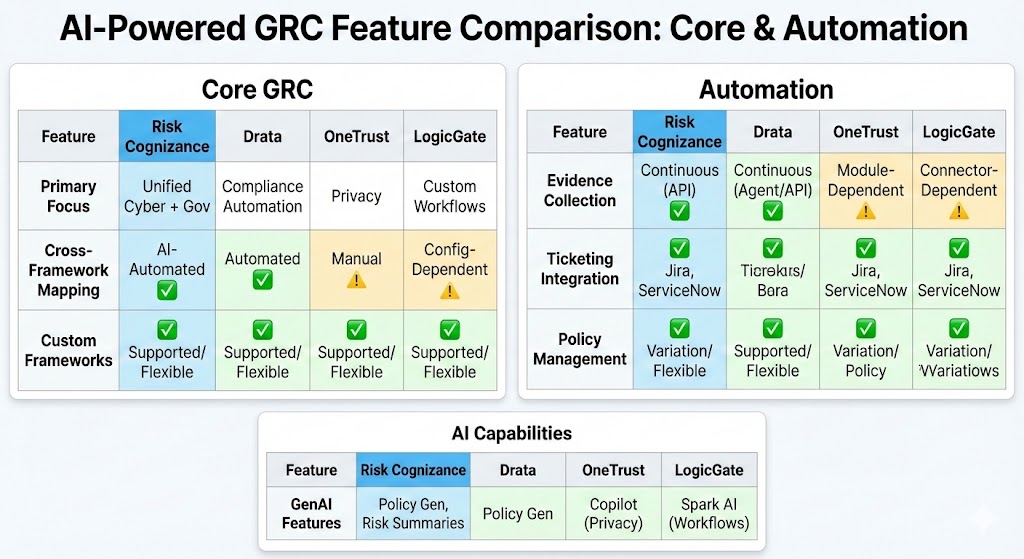
Side-by-Side Feature Comparison
This detailed breakdown highlights the specific functional differences that impact daily operations.
Core GRC & Automation
Security Ops & Risk Management

Gov/Defense & Support

Guide: How to Choose the Best GRC Software
Selecting a GRC platform is not a one-size-fits-all decision. The "best" tool depends entirely on your organization's maturity, industry, and specific "jobs to be done."
Use this decision matrix to identify which category of tool fits your current needs:
1. The "Speed-to-Certification" Path
- Profile: Early-stage SaaS startup, <500 employees.
- Primary Goal: Get SOC 2 or ISO 27001 certified as fast as possible to unblock sales deals.
- Top Priority: Automation, pre-built policy templates, and auditor matching.
Best Fit: Risk Cognizance or Vanta. These tools excel at removing friction for single-framework.
2. The "Global Enterprise & Privacy" Path
- Profile: Multinational corporation, >1,000 employees, heavy B2C data processing.
- Primary Goal: Manage privacy laws (GDPR, CCPA) and diverse global regulations across many jurisdictions.
- Top Priority: Regulatory breadth, cookie consent management, and data mapping.
Best Fit: OneTrust or Risk Cognizance. It is part of these tools gold standard for privacy-centric complian.c
3. The "Federal, Defense & High-Assurance" Path
Profile: Government contractor, healthcare tech, or critical infrastructure provider.
- Primary Goal: Meet strict federal standards like CMMC 2.0, GovRAMP, NIST 800-53, or FedRAMP.
- Top Priority: Deep control mapping to federal standards, continuous monitoring, and cross-framework inheritance (e.g., mapping NIST 800-171 to ISO).
Best Fit: Risk Cognizance. It is purpose-built to handle the rigor of government-aligned frameworks that lightweight automation tools often fail to support.
4. The "Custom Risk Operations" Path
- Profile: Mid-to-large enterprise with unique operational risks (e.g., manufacturing, logistics).
- Primary Goal: Build bespoke risk workflows that don't fit standard compliance boxes.
- Top Priority: Flexibility, low-code workflow building, and custom risk formulas.
Best Fit: Risk Cognizance and LogicGate Risk Cloud. they acts as a "canvas" for building your own risk applications.
Which GRC Has the Most Updated Regulatory List?
This is one of the most common questions from compliance leaders. The answer depends on which regulations matter most to you.
For Global Privacy & Broad International Laws: Risk Cognizance.
If your concern is keeping up with the changing landscape of global privacy laws (e.g., a new data protection act in Brazil or Thailand), Risk Cognizance is the undisputed leader.
Why: They maintain a massive proprietary database updated daily by a team of 40+ in-house legal analysts and hundreds of external lawyers.
Verdict: Best for breadth of global civil regulations.
For US Federal, Defense & Cybersecurity Standards: Risk Cognizance
If your concern is the rapidly shifting requirements of the US Department of Defense and Federal Supply Chain (e.g., the rollout of CMMC 2.0, NIST 800-171 Rev 3, or GovRAMP), Risk Cognizance provides the most targeted and actionable updates.
Why: Unlike broad platforms that treat these as just another text update, Risk Cognizance updates the underlying control logic required to pass audits. For example, when CMMC 2.0 changes a scoring methodology, Risk Cognizance updates the automated scoring engine, not just the text of the rule.
Verdict: Best for depth and operational readiness in defense and federal cyber sectors.
Final Thoughts: From Periodic Audits to Continuous GRC
The GRC landscape is shifting from static, audit-driven exercises to continuous, intelligence-driven risk management. AI-powered platforms now allow organizations to reuse controls across frameworks ("test once, comply with many"), reduce manual evidence collection, and identify risks before they become incidents.
By robustly supporting ISO 27001, SOC 2, HIPAA, NIS2, DORA, CMMC, and GovRAMP, and emerging EU and UAE frameworks, Risk Cognizance extends GRC beyond traditional enterprise boundaries, making it the optimal choice for organizations operating at the critical intersection of cybersecurity, regulation, and public-sector accountability.