

EU AI Act
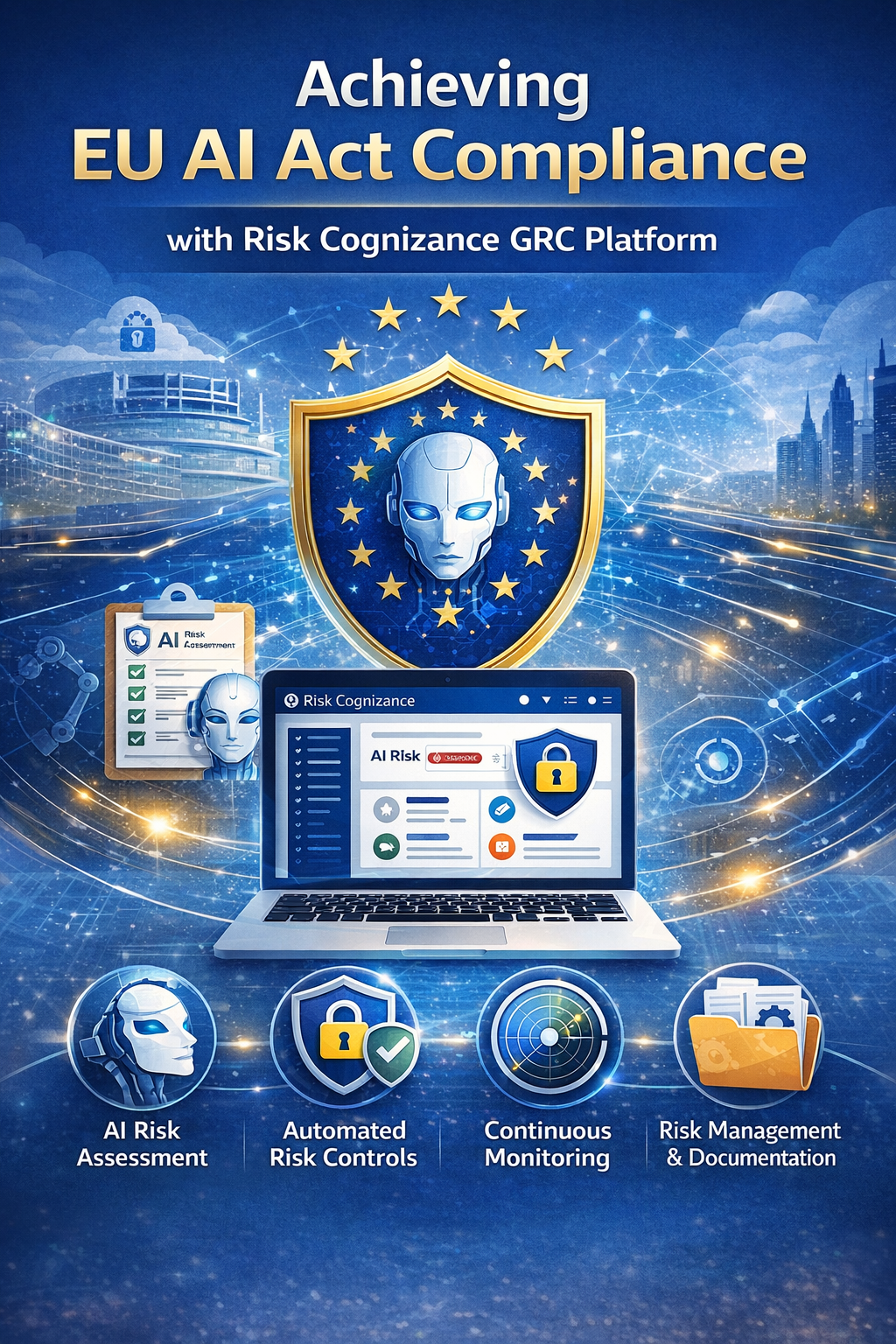
EU AI Act
Navigating the EU AI Act with Risk Cognizance: A Complete Guide to AI Governance and Compliance
Introduction: The New Era of AI Regulation
Artificial Intelligence is transforming industries—but with innovation comes risk. To ensure AI systems are safe, transparent, and trustworthy, the European Union has introduced the EU AI Act, the world’s first comprehensive regulatory framework for AI.
For organizations building or deploying AI systems, compliance is no longer optional. The EU AI Act introduces strict requirements around risk management, transparency, accountability, and continuous monitoring.
However, managing these requirements manually is complex and unsustainable.
This is where Risk Cognizance, a modern Governance, Risk, and Compliance (GRC) platform, becomes essential—helping organizations operationalize AI compliance at scale.
Understanding the EU AI Act
- The EU AI Act takes a risk-based approach, categorizing AI systems into four levels:
1. Unacceptable Risk
- AI systems that threaten safety or fundamental rights (e.g., social scoring) are prohibited.
2. High Risk
Systems used in critical areas such as:
- Healthcare
- Law enforcement
- Financial services
- Critical infrastructure
These systems face the strictest requirements.
3. Limited Risk
- AI systems requiring transparency (e.g., chatbots must disclose they are AI).
4. Minimal Risk
- Low-risk applications with minimal regulatory burden.
Key Compliance Requirements
- Organizations dealing with high-risk AI systems must implement:
- Risk Management Systems
- Data Governance & Quality Controls
- Technical Documentation
- Transparency & Explainability
- Human Oversight Mechanisms
- Continuous Monitoring & Incident Reporting
These requirements mirror and extend traditional compliance frameworks—but introduce new complexities specific to AI.
Challenges in Achieving EU AI Act Compliance
1. Lack of AI Governance Frameworks
- Most organizations do not yet have structured AI governance models.
2. Fragmented Risk Management
- AI risks (bias, drift, explainability) are often managed separately from enterprise risk programs.
3. Documentation Overload
- The EU AI Act requires detailed, auditable documentation across the AI lifecycle.
4. Continuous Compliance Requirements
- Organizations must monitor AI systems post-deployment—not just during development.
How Risk Cognizance Enables EU AI Act Compliance
- Risk Cognizance provides a centralized GRC platform that integrates AI governance into broader enterprise risk and compliance programs.
1. AI Risk Classification & Assessment
- Risk Cognizance helps organizations:
- Classify AI systems based on EU AI Act risk levels
- Conduct automated risk assessments
- Identify high-risk AI use cases early
This ensures organizations understand their regulatory exposure from the start.
2. Integrated Risk Management
- The platform unifies AI risk with enterprise risk by:
- Tracking AI-specific risks (bias, fairness, model drift)
- Linking risks to controls and mitigation strategies
- Providing real-time risk scoring and dashboards
- This holistic approach ensures AI risks are not managed in isolation

3. Automated Control Frameworks
- Risk Cognizance aligns EU AI Act requirements with existing frameworks such as:
- ISO 27001
- NIST AI Risk Management Framework
- SOC 2
- This allows organizations to reuse existing controls and avoid duplication.
4. Documentation & Audit Readiness
The platform centralizes:
- Technical documentation
- Model development records
- Data governance policies
- Risk assessments
All artifacts are mapped directly to compliance requirements, ensuring full traceability during audits.
5. Continuous Monitoring & Lifecycle Governance
Risk Cognizance enables:
- Real-time monitoring of AI systems
- Alerts for model drift or anomalies
- Ongoing compliance tracking
This ensures organizations remain compliant even as AI systems evolve.
6. Human Oversight & Accountability
The EU AI Act emphasizes human control over AI systems.
- Risk Cognizance supports this through:
- Role-based access controls
- Approval workflows
- Decision tracking and audit logs
This creates accountability across the AI lifecycle.
End-to-End EU AI Act Compliance Workflow
With Risk Cognizance, organizations can manage the full lifecycle:
- AI System Inventory & Classification
- Risk Assessment & Categorization
- Control Implementation & Governance Setup
- Documentation & Evidence Collection
- Audit Preparation & Reporting
- Continuous Monitoring & Improvement
Business Benefits of Using Risk Cognizance
Organizations leveraging Risk Cognizance for EU AI Act compliance gain:
Faster Compliance Readiness
- Automated workflows reduce time to compliance.
Reduced Operational Risk
- Proactive monitoring minimizes AI-related failures.
Improved Transparency
- Clear documentation builds trust with regulators and customers.
Scalable Governance
- Easily extend compliance across multiple AI systems and jurisdictions.
Competitive Advantage
- Demonstrate responsible AI practices to stakeholders and regulators.
EU AI Act as a Strategic Opportunity
While many organizations view the EU AI Act as a regulatory burden, forward-thinking companies see it as an opportunity to:
- Build trust in AI systems
- Strengthen governance frameworks
- Differentiate in the market
Risk Cognizance enables organizations to turn compliance into a strategic advantage.

Future-Proofing AI Compliance
AI regulation is evolving globally. Beyond the EU AI Act, organizations must prepare for:
- Additional regional AI regulations
- Industry-specific requirements
- Increasing scrutiny on AI ethics and transparency
Risk Cognizance provides a future-ready compliance foundation, allowing organizations to adapt quickly to new regulatory landscapes.
Conclusion
The EU AI Act marks a turning point in how AI is governed. Organizations must move beyond ad hoc approaches and adopt structured, scalable compliance strategies.
- Risk Cognizance empowers organizations to:
- Operationalize AI governance
- Integrate AI risk into enterprise GRC
- Maintain continuous compliance
