

GovRAMP
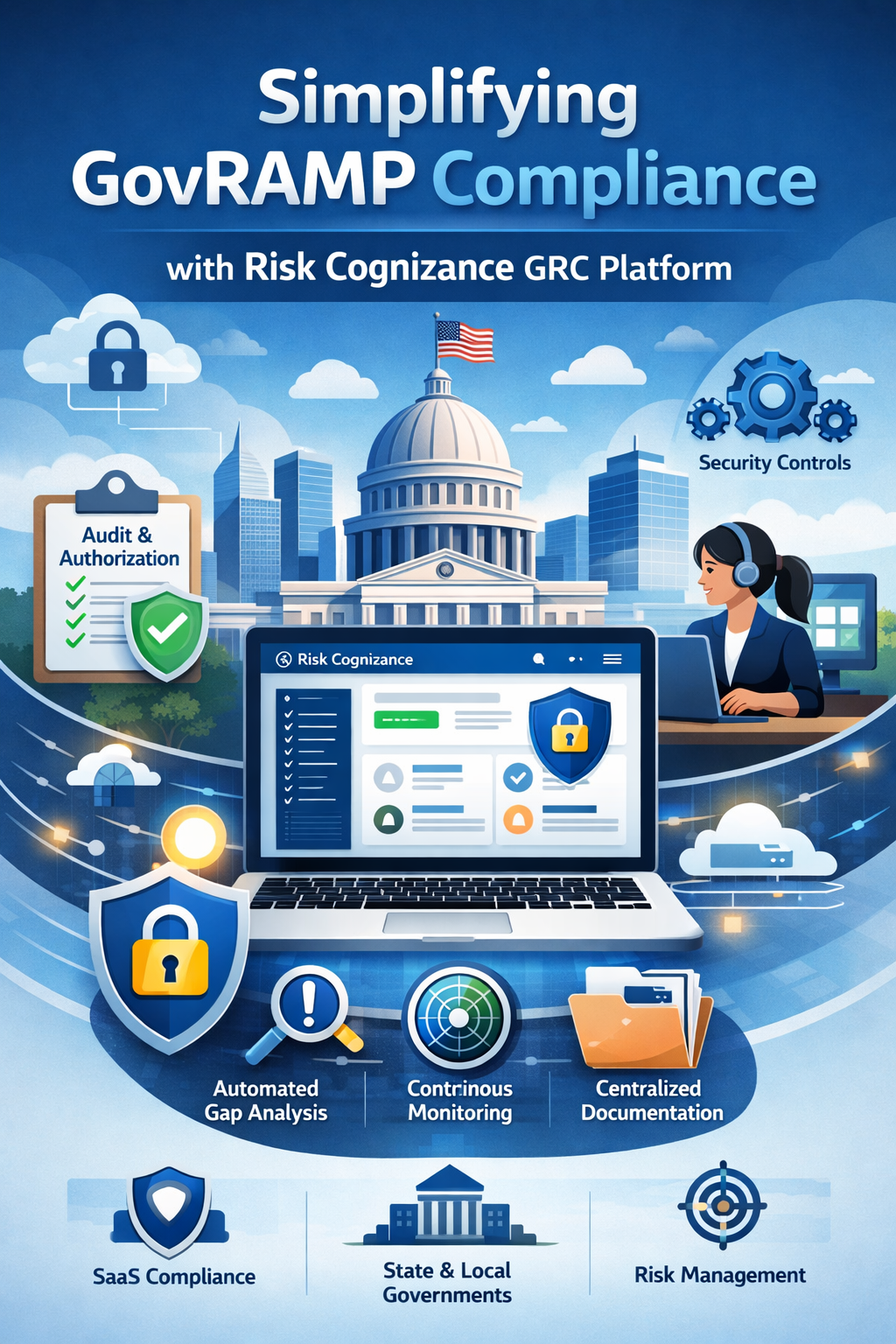
GovRAMP
The Complete Guide to Achieving GovRAMP Compliance with Risk Cognizance
Introduction: The Growing Importance of GovRAMP
As state and local governments accelerate digital transformation, cloud adoption has become unavoidable. However, with increased reliance on SaaS platforms comes a heightened need for standardized cybersecurity assurance. GovRAMP (Government Risk and Authorization Management Program) was created to address this need—providing a unified framework to assess and monitor cloud vendors.
For SaaS providers, GovRAMP is no longer optional. It is quickly becoming a baseline requirement for selling into the public sector. Yet, achieving GovRAMP compliance is resource-intensive, requiring structured documentation, control implementation, risk tracking, and continuous monitoring.
This is where Risk Cognizance transforms the process.
Understanding GovRAMP Requirements
GovRAMP is heavily aligned with NIST 800-53 controls, meaning organizations must demonstrate:
- Comprehensive security controls across administrative, technical, and physical domains
- Continuous monitoring of systems and risks
- Documented policies and procedures
- Evidence-based validation of compliance
- Third-party assessment readiness

Organizations pursuing GovRAMP must typically move through maturity levels such as:
- Baseline Readiness
- Provisional Authorization
- Authorized Status
Each level increases expectations for control maturity, documentation depth, and operational rigor.
Key Challenges Organizations Face
- Without a centralized platform, companies often struggle with:
1. Fragmented Compliance Efforts
- Teams rely on spreadsheets, shared drives, and disconnected tools, leading to inconsistencies and duplication.
2. Lack of Real-Time Visibility
- Executives and compliance leaders lack a clear view of current risk posture and control effectiveness.
3. Manual Evidence Collection
- Preparing for audits becomes a time-consuming process of chasing documentation across teams.
4. Control Mapping Complexity
- Aligning GovRAMP requirements with existing frameworks (SOC 2, ISO 27001) is difficult without automation.
How Risk Cognizance Solves These Problems
- Risk Cognizance provides a centralized GRC ecosystem designed to manage the full lifecycle of GovRAMP compliance.
Unified Control Framework
- The platform maps GovRAMP controls directly to other standards, enabling organizations to leverage existing compliance investments rather than duplicating effort.
Automated Gap Analysis
- Instead of manual reviews, Risk Cognizance automatically identifies missing or weak controls, prioritizing them based on risk impact.
Continuous Monitoring
- The platform tracks control effectiveness in real time, ensuring compliance is maintained—not just achieved once.
Evidence Automation
- Evidence is collected, stored, and linked to controls continuously, drastically reducing audit preparation time.
End-to-End GovRAMP Workflow in Risk Cognizance
- Initial Assessment – Evaluate readiness against GovRAMP baselines
- Gap Identification – Highlight deficiencies and risks
- Remediation Planning – Assign tasks and track progress
- Control Implementation – Deploy policies and safeguards
- Audit Preparation – Compile evidence and generate reports
- Continuous Compliance – Monitor and maintain authorization
Business Impact
- Organizations using Risk Cognizance for GovRAMP typically achieve:
- Faster time to authorization
- Reduced compliance costs
- Improved audit outcomes
- Stronger security posture
- Increased trust with government buyers
Conclusion
- GovRAMP compliance is complex—but with the right platform, it becomes manageable and scalable. Risk Cognizance enables organizations to move beyond reactive compliance and build a proactive, resilient security program.
2. GovRAMP Compliance Lifecycle: A Deep Dive with Risk Cognizance
Introduction
- GovRAMP is not a one-time certification—it is a continuous lifecycle. Organizations must maintain compliance through ongoing monitoring, updates, and reassessments.
Risk Cognizance is purpose-built to support this lifecycle.

Phase 1: Readiness & Gap Assessment
- Before pursuing GovRAMP, organizations must understand their current state.
- Risk Cognizance automates this process by:
- Scanning existing controls
- Mapping them to GovRAMP requirements
- Generating a detailed gap report
- This allows teams to focus on high-priority risks first.
Phase 2: Remediation & Control Implementation
Once gaps are identified, organizations must implement controls.
- Risk Cognizance supports this with:
- Pre-built policy templates
- Task management workflows
- Risk-based prioritization
- Ownership tracking
This ensures accountability across teams.
Phase 3: Documentation & Evidence Management
Documentation is critical for GovRAMP.
- Risk Cognizance centralizes:
- Policies and procedures
- Risk assessments
- Control evidence
- Audit trails
All documentation is linked directly to relevant controls, ensuring traceability.
Phase 4: Audit & Authorization
- Preparing for a third-party assessment is often the most stressful phase.
- Risk Cognizance simplifies this by:
- Generating audit-ready reports
- Providing real-time compliance dashboards
- Ensuring all evidence is complete and up to date
Phase 5: Continuous Monitoring
- Post-authorization, organizations must maintain compliance.
- Risk Cognizance enables:
- Real-time risk alerts
- Automated control testing
- Continuous evidence collection
- Ongoing reporting
Conclusion
By managing the full lifecycle, Risk Cognizance ensures that compliance is not just achieved—but sustained.
3. GovRAMP vs. Traditional Compliance: Why Risk Cognizance Changes the Game
The Old Way of Compliance
- Traditional compliance approaches rely on:
- Static spreadsheets
- Periodic audits
- Manual documentation
- Siloed teams
- This leads to inefficiencies and increased risk.
The GovRAMP Reality
- GovRAMP demands:
- Continuous monitoring
- Real-time visibility
- Strong governance
- Scalable processes
- Traditional methods simply cannot keep up.
Risk Cognizance: A Modern Approach
- Risk Cognizance introduces a dynamic, automated compliance model.
Real-Time Dashboards
- Executives can instantly see compliance status and risk exposure.
Integrated Risk Management
- Risks are tracked alongside controls, providing context for decision-making.
Automation-Driven Compliance
- Manual tasks are replaced with automated workflows.
Strategic Advantages
- Organizations using Risk Cognizance gain:
- Competitive differentiation in government markets
- Faster procurement approvals
- Reduced operational overhead
- Improved security maturity
4. Scaling GovRAMP and Beyond with Risk Cognizance
The Challenge of Multi-Framework Compliance
- Most organizations don’t stop at GovRAMP. They also pursue:
- SOC 2
- ISO 27001
- FedRAMP
- Managing these simultaneously is complex.
Risk Cognizance Multi-Framework Capability
- Risk Cognizance allows organizations to:
- Map controls across frameworks
- Reuse evidence
- Eliminate duplication
- Maintain a single source of truth
Future-Proofing Compliance
- With Risk Cognizance, organizations can:
- Scale compliance programs as they grow
- Adapt to new regulations
- Maintain continuous readiness
